501-918-3025
calsfoundation@cals.org
calsfoundation@cals.org
Franklin Williams is one of many Arkansans who served in the armed forces of the United States during both World War II and the Korean War. His collection at the Butler Center for Arkansas Studies at the Central Arkansas Library System contains a notable sample of the type of communications developed on behalf of those in military service in the middle of the twentieth century.
Ernest Franklin Williams was born on February 17, 1917, in Galatin, Tennessee. His family moved to Arkansas, settling in Batesville in 1924 when his father was hired to teach at Arkansas College (now Lyon College). Williams graduated from Arkansas College in 1938 and then obtained an engineering degree from the University of Arkansas in Fayetteville. He volunteered for service in World War II and was made a lieutenant in the United States Army Air Corps, serving from 1943 to 1946.
Williams then attended the Washington School of Dentistry in St. Louis, Missouri, receiving his DDS degree in 1950. He opened an office in Batesville and practiced dentistry in Batesville for forty-seven years; he also served as a dentist in the United States Air Force during the Korean War. He died on July 11, 2007.
A note on the letters in the collection: When the United States prepared for war at the beginning of the 1940s, texting and emailing and even faxing had not yet been invented. Those planning the war effort knew the importance of letters from home to maintain the morale of the troops. But the bulk of mail that would have to be carried overseas and delivered, with written responses returned, would have meant an extra burden on resources needed to send troops, equipment, and supplies where they were needed.
V-mail was invented to solve this problem. (The “V” stands for “Victory.”) Those wishing to correspond were given one-page forms on which they would write or type their messages. These messages were then photographed, with the copies saved on microfilm. The miniaturized messages were delivered to their destination, then printed on special paper and handed to the recipient. This conversion released thousands of tons of shipping space while enabling soldiers to keep in touch with their families and friends.

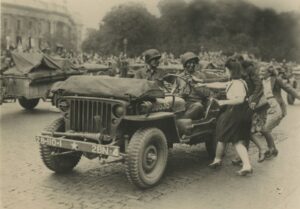
The Butler Center’s Franklin Williams collection contains more than one hundred V-mails that were sent to Lieutenant Williams while he was stationed in Europe, along with several photographs that Williams took himself, and others that he purchased in France after its liberation toward the end of the war.
The finding aid for the Williams collection is available here.
The Butler Center possesses several collections with material about the Japanese Americans who were held in Arkansas in internment camps at Rohwer and Jerome during World War II. A collection recently acquired and made available to researchers is the D. J. Hudson collection.
D. J. Hudson (occasionally written out as Dee Jay Hudson) was born in Moreland (Pope County) to Herman and Pearl Hudson in 1913. In 1940, he was a mess steward at the Civilian Conservation Corps camp in Russellville. With the arrival of Japanese internees in Arkansas in 1942, Hudson became commandant of the school at the Jerome Relocation Center. He was then named chief project steward at Jerome. Later, he held the same position at the Rohwer Relocation Center.
Hudson’s collection contains correspondence with the War Relocation Authority (WRA) from 1942 through 1945. It also contains samples of paperwork used by the WRA to oversee the camps. Included among these samples are an inventory of school furniture and equipment from 1942 and a Rating Official’s Guide from December 1943.
The finding aid for the Hudson collection is available here.
Header image: Ernest Franklin Williams among other soldiers stationed in France around the end of World War II. Lieutenant Williams is at the center of the group. He is wearing a darker uniform, and an “L”-shaped scratch on the photograph is on his chest.
Both the Williams collection and the Hudson collection can be accessed in the Research Room of the CALS Roberts Library; visiting information is here.
By Steve Teske, archivist at the CALS Butler Center for Arkansas Studies/Roberts Library