501-918-3025
calsfoundation@cals.org
calsfoundation@cals.org
With Lunar New Year beginning today, February 17, I’ve been digging through old boxes and bins at my parents’ house, searching for photos and videos of how my family has celebrated this holiday over the years.

Lunar New Year is one of the most significant celebrations in Chinese culture. It is a holiday dedicated to honoring the people who came before us—our ancestors and past loved ones—as well as a time to celebrate the fresh start and fortune of a new year in the lunisolar calendar. Traditionally, it’s a lively fifteen-day festival celebrated with extended family; the days are filled with dragon dancers, fireworks, dumplings, and red and gold decorations.
In years when we were able to celebrate with extended family, we filled up on delicious dim sum (with shumai, BBQ pork buns, sesame balls, and egg tarts), collected a pile of red envelopes with money inside, and stayed up late, chatting and laughing in a room filled with aunties, uncles, and cousins.
Most years, however, we were in Little Rock, where the Asian population was small. (Read more here about Chinese in Arkansas.) There were no nearby festivals or dragon dancers, and without extended family, our celebrations were often just the five of us. So, my family adapted.
My parents hosted Lunar New Year parties and invited friends from school, church, and the community, many of whom had little to no exposure to Chinese cultural traditions. We hung red lanterns around the house, taught folks how to use chopsticks, and filled the entire table with dumplings.

Our celebrations looked different from year to year. One year, we gathered around the table and folded hundreds of dumplings. Other years, we set up an elaborate hot pot—a communal meal where an electric wok sits in the middle of the table boiling broth, and everyone throws in different prepared meats, veggies, and dumplings. For each celebration, in whatever way it would take shape, we invited friends to join us.
Eventually, Lunar New Year traditions expanded beyond our family. One woman from my parents’ church, Ms. Treopia, began sending my sisters and me cards in red mailing envelopes filled with two-dollar bills. I still have every card she wrote, each one a reminder of the tradition she chose to share with us. (She has since told me that she plans on continuing this tradition for the next generation of the Li family.) Another family friend, Joy, gave me a doll of a little Chinese girl in a red silk qipao, a traditional dress with a high Mandarin collar often worn during the holiday. I held on to this doll as well, moved that someone would go out of their way to find one that looked like me.
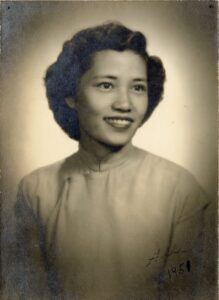
A couple years ago, Lunar New Year fell on my birthday. That year, I found a qipao of my own. It was not traditional—it was green and plaid instead of red and silk—but regardless, I wore it for my birthday/Lunar New Year dinner. That night, my dad pulled up a black-and-white photo of my Popo at my age in a qipao and told me I looked just like her. He sent her the photo of me in my qipao, and she was deeply touched. Even though it wasn’t perfectly accurate to the formal tradition of a red silk qipao, she was delighted by my attempt to hold on to our cultural traditions.
Over time, I’ve realized that these items—the cards from Ms. Treopia, the doll, the photos from our celebrations, my plaid green qipao—were not just evidence of the tradition that we tried to maintain, but of the new traditions my family created to stay connected to our history. It is nearly impossible to hold on to traditions exactly as they began. Traditions naturally evolve for everyone. They might manifest in different ways in your family—maybe a family recipe was altered because a key ingredient is harder to find or a gathering looks different after the loss of a loved one. What matters most is their continuation and the threads that connect our past and our present.
For me, this shift in perspective has resulted in digitizing the Lunar New Year cards Ms. Treopia sent me every year and digging for the photos of our Lunar New Year celebrations to properly store them.

This Lunar New Year, whether you celebrate the holiday or not, I encourage you to reflect on your own family traditions. Preserve the history of the people who came before you but also preserve the memories and traditions you are creating now. By capturing both our history and our present adaptation of these traditions, we ensure the story of how we celebrated and adapted doesn’t become lost to time. And in doing this work of personal archiving, we leave something meaningful for the next generation to pick up and adapt for themselves.
If you would like to learn about the process of archiving your family memorabilia, please visit RobertsLibrary.org/PersonalArchiving to register for our free monthly Personal Archiving class. To make an appointment with the DIY Memory Lab, visit RobertsLibrary.org/MemoryLab.
By Meredith Li, CALS Memory Lab coordinator